
Guide
Alcohol-Induced Psychosis: Hallucinations and Paranoia in Withdrawal, How It Differs From Delirium Tremens, and When to Call 911
Joint Commission accredited · In network with most major insurance · Admissions answered 24 hours a day

Published October 3, 2026
Hearing voices or seeing things on the second day without a drink is frightening, and the fear is justified, but not for the reason most people assume. Alcohol-induced psychosis on its own is uncommon, usually brief, and treatable. The danger is in what it can be mistaken for or turn into: delirium tremens, which looks similar from the outside and kills people who are left to sleep it off. This page explains what alcohol-induced psychosis is, when it starts and stops, how a clinician tells it from delirium, which signs mean 911 now, and what happens afterward. Every figure is from the clinical references named under each section.
What is alcohol-induced psychosis?
Alcohol-induced psychosis is hallucinations, paranoia or fixed false beliefs brought on by heavy drinking or by stopping it, in a person who otherwise knows where they are and what day it is.
The clinical reference StatPearls also calls it alcohol hallucinosis, and describes it as clinically similar to schizophrenia but a distinct condition, characterized by hallucinations, paranoia and fear. It can appear during intoxication, during withdrawal, or in long-term heavy drinkers between the two. It is uncommon: a Dutch literature review cited by StatPearls puts lifetime prevalence at 0.4 percent of the general population and 4 percent of people with alcohol dependence, and a Finnish general-population study found 0.5 percent overall, rising to 1.8 percent among working-age men. Both sources note it is probably under-counted, because it is usually noticed only when someone is admitted to a hospital for something else and withdrawal begins.
What it is not is a sign that a person has “gone crazy” or developed a lifelong illness. In most cases the psychosis follows the alcohol, and when the alcohol stops for good, so does it.
Source: Alcohol-Related Psychosis, Stankewicz, Richards and Salen, StatPearls, updated July 10, 2023; Alcohol-induced psychotic disorder and delirium in the general population, Perälä et al., British Journal of Psychiatry, 2010.
What are the symptoms of alcohol-induced psychosis?
The symptoms of alcohol-induced psychosis are mainly auditory hallucinations and paranoia: voices, often threatening or accusing, and a conviction of being watched, followed or plotted against.
StatPearls’ withdrawal chapter describes alcohol hallucinosis as consisting primarily of auditory hallucinations and paranoia. Visual and tactile hallucinations occur too, shapes at the edge of vision or the feeling of something on the skin, and the National Library of Medicine’s phrase for the withdrawal form is seeing or feeling things that are not there. Clinicians watch for a person responding to internal stimuli, turning toward a sound no one else hears, and for flat affect.
The feature that defines it, and that separates it from the more dangerous condition in the next sections, is that the person remains oriented. They know who they are and where they are, their memory works, and they can usually describe what they are hearing even while they believe it. The StatPearls psychosis chapter is specific that the hallucinations or delusions must be more than what intoxication or ordinary withdrawal would explain.
Source: Alcohol Withdrawal Syndrome, Canver, Newman and Gomez, StatPearls, updated February 14, 2024; Alcohol withdrawal, MedlinePlus Medical Encyclopedia, National Library of Medicine, reviewed January 1, 2025.
When do hallucinations start in alcohol withdrawal, and how long do they last?
Hallucinations in alcohol withdrawal usually start 12 to 24 hours after the last drink and clear within 48 to 72 hours. They affect roughly 2 percent of people going through withdrawal.
That timing comes from the standard four-stage withdrawal timeline: minor symptoms at 6 to 12 hours, hallucinations at 12 to 24, seizures most likely at 24 to 48, and delirium tremens from 48 to 72 hours. The hour-by-hour alcohol withdrawal page sets out the whole sequence with its sources. StatPearls gives the figure of about 2 percent for alcohol hallucinosis in withdrawal, says the hallucinations usually subside within 48 hours of the last drink, and puts full resolution within 72 hours.
Two cautions. Withdrawal seizures can occur as early as 8 hours after the last drink and without any other warning symptoms, so hallucinations are not the first sign that withdrawal has turned serious. And hallucinations that are still present on day four, or that arrive with confusion, are no longer alcohol hallucinosis by this definition and need urgent evaluation.
Source: Alcohol Withdrawal Syndrome, Canver, Newman and Gomez, StatPearls, updated February 14, 2024.
What is the difference between alcohol hallucinosis and delirium tremens?
The difference is confusion. In alcohol hallucinosis the person hallucinates but stays oriented; in delirium tremens the person is disoriented, with fever, heavy sweating, a racing heart and severe agitation on top of the hallucinations, and it is a medical emergency.
The National Library of Medicine describes delirium tremens as a severe form of withdrawal with sudden and severe mental or nervous system changes, most often beginning 48 to 96 hours after the last drink but sometimes 7 to 10 days later. Its list runs from agitation and body tremors through sudden severe confusion, fever, hallucinations, bursts of energy, sensitivity to light and sound, and stupor. It occurs most often in people with a history of alcohol withdrawal and in those who have drunk heavily for many years, and it requires a hospital stay.
The mortality figures are why the distinction matters. StatPearls notes that the death rate from withdrawal delirium was historically as high as 20 percent and is now around 1 percent with prompt diagnosis and treatment, which is to say that the outcome depends almost entirely on whether the person is in a hospital when it happens. Benzodiazepines given early reduce the risk of progression. The seizures and DTs timeline page covers that progression in detail.
Source: Delirium tremens, MedlinePlus Medical Encyclopedia, National Library of Medicine, reviewed January 1, 2025; Alcohol Withdrawal Syndrome, StatPearls, 2024.
Where we are
Detox centers across Texas
Three locations, each with its own admissions line and its own clinical team. Pick the one nearest you — or call and we will tell you which has a bed tonight.
-
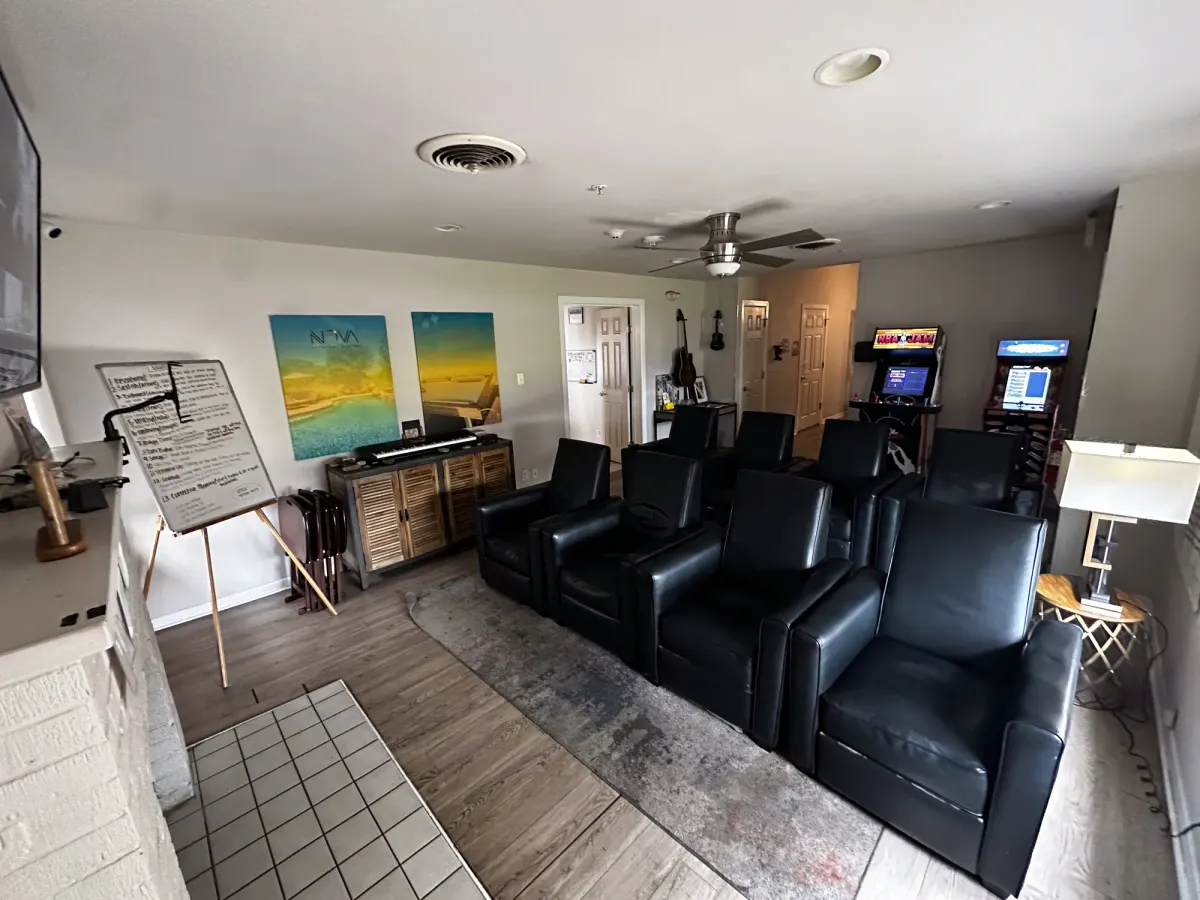 Inpatient
Austin, TX
11711 N Lamar Blvd · 78753
- 15 beds
- On-site labs
- 24-hour medical staff
Drug & Alcohol Detox in Austin, TX
-
 Inpatient
Houston, TX
1019 Ashland St · 77008
- On-site labs
- 24-hour medical staff
Drug Detox Center in Houston, TX
-
 Outpatient
San Antonio, TX
6707 W Hausman Rd · 78249
- Outpatient detox with scheduled medical visits
- Outpatient treatment
Outpatient Drug & Alcohol Detox in San Antonio
When is alcohol-induced psychosis an emergency?
Alcohol-induced psychosis is an emergency when confusion, a seizure, fever, a racing or irregular heartbeat, or heavy sweating comes with it, and whenever it is a person’s first episode of psychosis. Call 911 rather than driving.
The National Library of Medicine lists the signs a clinician looks for in delirium tremens: heavy sweating, an exaggerated startle, irregular heartbeat, problems with eye movement, rapid breathing, rapid heart rate and rapid tremors. Any of them alongside hallucinations means the person may be moving from hallucinosis into delirium, and that transition is the one that kills.
A first episode of psychosis needs emergency evaluation for a different reason. StatPearls is direct that a careful physical examination is required to rule out head injury and infection as causes of altered mental status, and both are common in people who drink heavily. Abnormal eye movements with confusion in a heavy drinker can also be Wernicke’s encephalopathy, a thiamine emergency described on the alcohol and memory page. Finally, StatPearls notes that alcohol-related psychosis carries a higher rate of suicidal behavior, so a person who is hallucinating and talking about harming themselves is not someone to watch overnight.
Source: Delirium tremens, MedlinePlus Medical Encyclopedia; Alcohol-Related Psychosis, StatPearls, 2023.
Why does alcohol cause psychosis?
Alcohol causes psychosis through changes in brain signaling that no single theory fully explains. The clinical references point to dopamine and serotonin disturbance in long-term heavy drinkers, and to the rebound overactivity of the nervous system in withdrawal.
StatPearls says the exact cause is unknown and the leading hypotheses involve increased dopamine activity and altered dopamine receptors, with serotonin and amino acid abnormalities also implicated, and imaging studies showing abnormal blood flow in several brain regions of people who hallucinate in alcohol dependence. The withdrawal form is easier to picture: the brain adapts to alcohol’s sedation by turning up its own excitatory signaling, and when the alcohol is removed that signaling runs unopposed, producing tremor, racing heart, seizures and, in a minority, hallucinations.
Who it happens to is better described than why. The Finnish study found higher risk with younger age at onset of dependence, low socioeconomic status, a father with mental health or alcohol problems, and multiple previous hospital treatments. StatPearls adds living alone and being unemployed. And a history of complicated withdrawal, meaning a past episode with seizures or delirium, is the strongest single predictor that the next withdrawal will be complicated too.
Source: Alcohol-Related Psychosis, StatPearls, 2023; Alcohol-induced psychotic disorder and delirium in the general population, Perälä et al., 2010.
How is alcohol-induced psychosis treated, and does it go away?
Alcohol-induced psychosis is treated with antipsychotic medication for the hallucinations and benzodiazepines for the withdrawal underneath, and it goes away in most people who stop drinking. It comes back in most people who do not.
StatPearls describes haloperidol as the first-line medication when sedation is needed for the psychosis itself, lorazepam or another benzodiazepine when withdrawal and seizures are the concern, and atypical antipsychotics such as olanzapine as alternatives. A 2014 review in Metabolic Brain Disease reached the same conclusion: antipsychotic treatment remains the preferred treatment, and the prognosis is usually good when abstinence can be maintained.
The long-term figures are sobering when abstinence is not maintained. StatPearls reports a 68 percent chance of readmission after a diagnosis, 37 percent comorbidity with other mental disorders, and a 5 to 30 percent risk of a chronic schizophrenia-like syndrome. The Finnish study followed its cases for eight years and found that 37 percent had died, from the medical consequences of the drinking rather than from the psychosis. Both sources put it the same way: the outlook is less favorable than older studies suggested, and good if the person can stop.
Source: Alcohol-induced psychotic disorder: a review, Jordaan and Emsley, Metabolic Brain Disease, 2014; Alcohol-Related Psychosis, StatPearls, 2023.
What does Briarwood do when someone is hallucinating in alcohol withdrawal?
Briarwood treats withdrawal hallucinations inside medically supervised alcohol detox, where a physician’s benzodiazepine protocol, thiamine, and nursing observation through the night are the tools that keep hallucinosis from becoming delirium.
The order of events matters. Briarwood is a detox center, not a hospital. A person who is already confused, feverish or seizing belongs in an emergency department first, and Briarwood’s admissions team will say so on the phone; detox begins once they are stable. A person who is hallucinating but oriented, or who has a history of complicated withdrawal and has not yet stopped drinking, is exactly who inpatient detox in Austin and Houston exists for, because the 48-to-72-hour window where delirium begins is spent under observation rather than at home. The San Antonio program is outpatient and is not the right setting for anyone with these symptoms.
Hallucinosis in withdrawal is also a signal about what comes next. It marks a dependence severe enough that the drinking has to stop entirely, and the step after detox is arranged before discharge for that reason. Cost and insurance covers what a stay costs with and without coverage. Admissions is answered at every hour, and if the question is whether someone’s voices are withdrawal or something worse, the first call is the place to ask it.
Common Questions
Can alcohol withdrawal cause hallucinations?+–
Yes. Alcohol hallucinosis affects about 2 percent of people in withdrawal, usually beginning 12 to 24 hours after the last drink and clearing within 48 to 72 hours. Hallucinations with confusion, fever or a racing heart are delirium tremens, which is an emergency.
How long does alcohol-induced psychosis last?+–
The withdrawal form usually resolves within 72 hours. Psychosis in long-term heavy drinkers can persist for weeks and is treated with antipsychotic medication; it usually clears with sustained abstinence and tends to recur with continued drinking.
What does alcohol-induced psychosis feel like?+–
Mostly voices, often threatening or accusing, and a strong sense of being watched or plotted against, while the person still knows where they are. Some people also see shapes or feel sensations on the skin.
Is alcohol-induced psychosis the same as delirium tremens?+–
No. In alcohol hallucinosis the person hallucinates but stays oriented. Delirium tremens adds severe confusion, fever, sweating, a racing heart and agitation, begins 48 to 96 hours after the last drink, and requires hospital care.
Is alcohol-induced psychosis permanent?+–
Usually not. It clears in most people who stop drinking. StatPearls reports a 5 to 30 percent risk of a chronic schizophrenia-like syndrome, concentrated in people who continue to drink, and a high rate of readmission.
What should I do if someone is hallucinating after they stopped drinking?+–
Do not leave them alone, and do not give them alcohol or sedatives to settle them. If they are confused, feverish, seizing, or talking about harming themselves, call 911. If they are oriented, they still need same-day medical evaluation, and a medically supervised detox can admit them before the delirium window.
Related guides


About the people behind this guide
Anna-Grace Washington
Medical Content Writer
Anna-Grace Washington is a Medical Content Writer for Briarwood Detox Center. She holds a master’s degree in clinical psychology from the University of Texas and brings a strong understanding of behavioral health, addiction recovery, and evidence-based treatment concepts to her writing.
In network with most major insurance
Find your plan and see what detox would cost
Most plans cover medical detox. Coverage varies by plan, so we verify it for you before you commit to anything.



















Don't see your plan? We work with out-of-network benefits and offer self-pay options — (866) 710-7710
- Confidential
- Takes about 2 minutes
- No obligation to admit

- Accredited The Joint Commission
- Rated 4.7 · 183 Google reviews Flourishing Foundations Recovery, now part of Briarwood
- Admissions 24 hours a day